

CIRCE has conducted an environmental impact assessment on the products developed within the CUBIC project. For this purpose, a Life Cycle Assessment (LCA) methodology was applied to quantify the environmental footprint of the products from a life cycle perspective. This approach allows for the evaluation of the potential environmental benefits associated with the use of bio-based materials as alternatives to conventional fossil-based materials. In addition, the LCA enables the identification of environmental hotspots across the value chain, thereby supporting informed decision-making aimed at improving product sustainability through eco-design strategies.
As defined by the Life Cycle Initiative in Towards a Life Cycle Sustainability Assessment, “life cycle sustainability assessment refers to the evaluation of all environmental, social, and economic impacts and benefits in decision-making processes towards more sustainable products throughout their life cycle.” The life cycle of a product encompasses all stages, from raw material extraction and processing, through manufacturing, distribution, and use, to final disposal or recycling. Product sustainability is assessed based on its three fundamental pillars according to the methodologies of the Environmental Life Cycle Assessment (e-LCA), Life Cycle Costing (LCC), and Social Life Cycle Assessment (s-LCA).
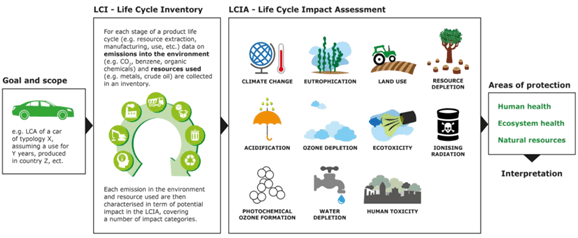
Within the context of the CUBIC project, a preliminary LCA has been conducted to evaluate the environmental impacts of the innovative materials developed and to compare them with conventional fossil-based alternatives. The analysis follows the Product Environmental Footprint (PEF) methodology, as recommended by the European Commission for assessing the environmental sustainability of new materials and products. This assessment provides robust information on the environmental performance and also enables the identification of process hotspots, potential improvement areas, and the benefits of bio-based materials compared to oil-based counterparts.
The results highlight the importance of performing life cycle assessments at early stages of product development. While bio-based solutions already demonstrate clear environmental advantages, several opportunities for further improvement have been identified. The findings of this study will support the optimisation of materials, processes, and value chains in subsequent project phases. Overall, this work contributes to the advancement of circular, bio-based materials with reduced environmental impacts, in alignment with European sustainability objectives.
In the coming months, the final environmental impact results will be obtained once the final materials and quantities in the formulations have been defined. In addition, the assessment will be complemented by an analysis of the economic and social impacts through Life Cycle Costing (LCC) and Social Life Cycle Assessment (s-LCA), providing a holistic evaluation of the three pillars of sustainability.


